 |
| Various
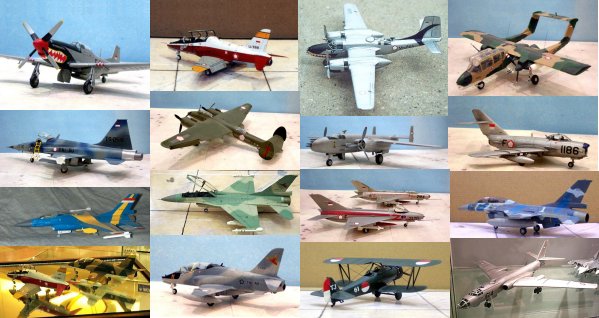
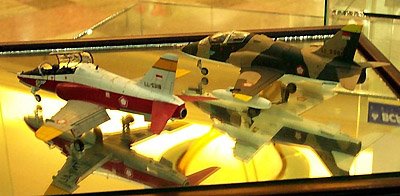
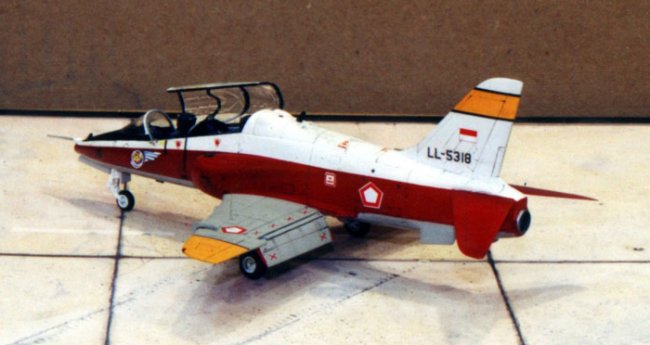
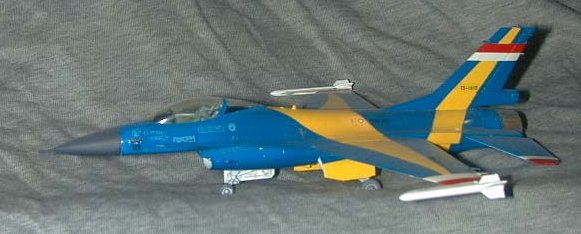
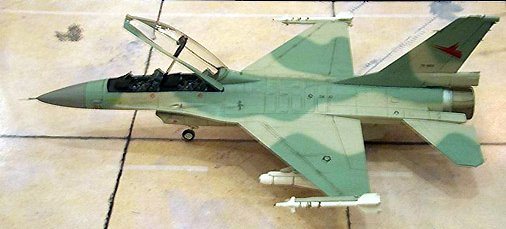
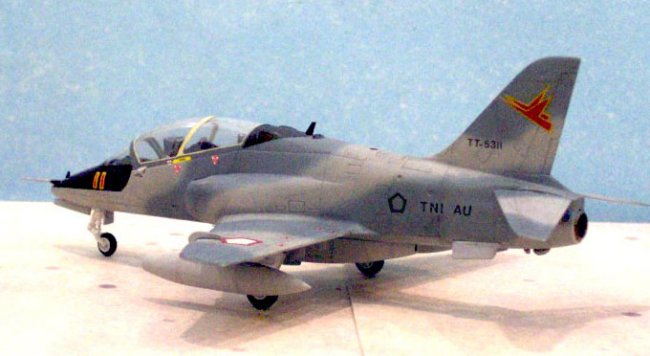
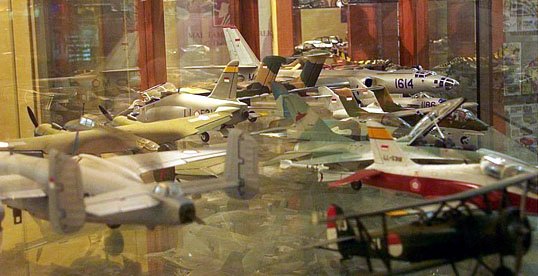
Indonesian AF models gathered at the club’s display |
The Indonesian Air Force,
known as TNI-AU (Indonesian National Armed Forces – Air Force) or previously
known as AURI (Republic of Indonesia Air Force) has a unique history as it has
operated aircraft from different origins, comprising ex-Japanese, Eastern-block
and Western aircraft. This unique and long history can be divided into several
chapters:
The
Early Days (1945-1950)
| After the Japanese
surrendered at the end of WW II, Indonesian nationalist leader Soekarno
declared Indonesian Independence on August 17th, 1945. Several
days later, a People Security Force was formed to undertake security
duties. The Air Division of this force was also formed, using ex-Japanese
planes scattered everywhere, especially in the island of
Java. The most numerous of these airplanes were the Kawanishi K5Y1 Willow
trainers, which were hastily used to train newly recruited cadets. At the
time of the founding, there was only 1 Indonesian holding a multi-engine
pilot licence from the pre-war Dutch Flying School (but never had any
opportunity to fly during the 3.5-year Japanese occupation). He was
assisted by a few Japanese pilots who decided to stay in the newly born
country. The new roundel was created simply by painting white on the lower
part of the Japanese Hinomaru, reflecting the red & white of
Indonesian flag. |
| Click
on image below to see larger image |
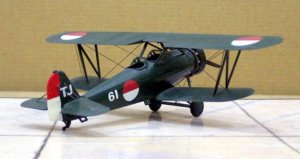 |
| K5Y1
Willow (Churen), a mile stone of Indonesian AF history (by Iwan) |
|
The
People Security Force was then re-organized to form a formal armed force. This
marked the birth of the Indonesian Air Force on April 9th, 1946.
However, tensions rose as the Dutch tried to re-claim her former colony and
launched an assault in July 21st, 1947, destroying most of the planes on the ground. Some planes survived though
and were hidden in remote bases.
July
29th, 1947 marked the first air operation by the newborn air force as
3 surviving aircrafts comprising 2 K5Y1 Willows and a
Ki-51 Sonia (the fourth aircraft, a Hayabusha/ Ki-43 Oscar, should also be
involved in the raid, but until the time the raid was launched, the aircraft
never reached airworthy condition) conducted air raids at dawn on Dutch
Army barracks in 3 cities of Semarang, Salatiga and Ambarawa, dropping
incendiary bombs. Tactically, these raids did not have any effect on the Dutch
positions, but psychologically it was a great success as it proved that the
Indonesian Air Force still exists. The Dutch had previously claimed the
destruction of Indonesian Air Force in their assault before and they never
expected any attack from the sky.
The
Gathering of Strength (1950-1960)
With
the pressure from the United Nations, the Dutch finally agreed to acknowledge
Indonesian independence and a peace treaty was signed in 1949, ending the
confrontation. The Dutch armed forces left (except in Papua, where they stayed
until 1963) and the airplanes were surrendered to the Indonesians. These
comprised of, among others, P-51, B-25, C-47 and PBY Catalina, which served as
the main forces of the Indonesian Air Force for the following decade. During
this era, Indonesia received her first jet aircraft; de Havilland DH-115
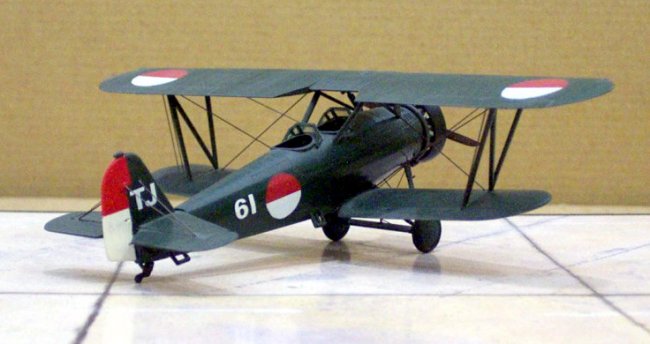
Vampire. It was also during this era that the national roundels were changed to
red & white pentagon.
|
Click on images below to
see larger images |
 |
 |
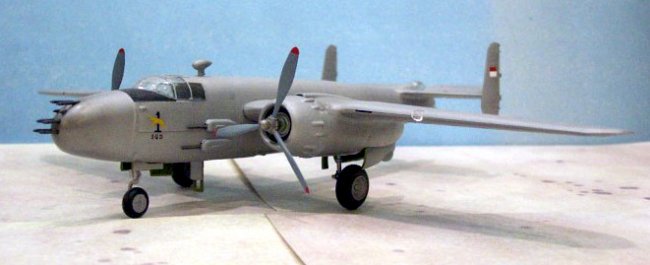
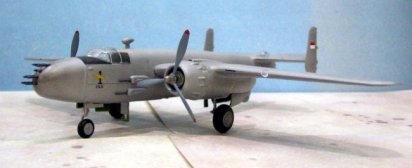
| B-25
Mitchell saw much combat against rebellions and confrontations (by
Rahman) |
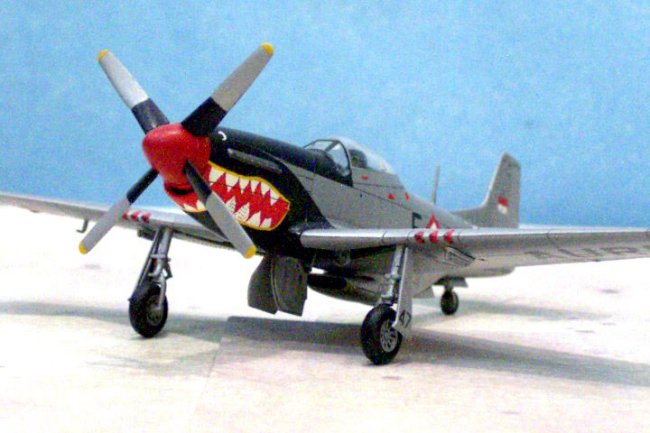
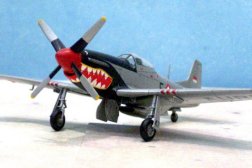
P-51D
Mustang, the Cadillac of the sky, also served Indonesian AF (by Iwan) |
The
Golden Age (1960-1970)
The
rise of the communist party in Indonesia has drawn Indonesia closer to the
Eastern Block. Several Soviet-built aircraft began to arrive in the early
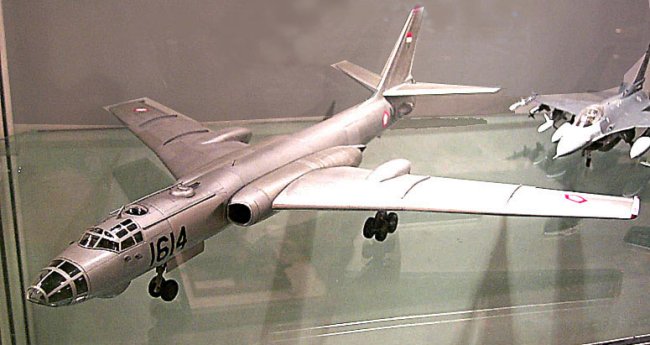
60’s. Indonesia even became the first non-Soviet country to receive and
operate the new Tu-16 Badger bombers. Up to 25 Tu-16 Badgers arrived and gave a
great deterrent power when facing some rebellions and confrontations. Several
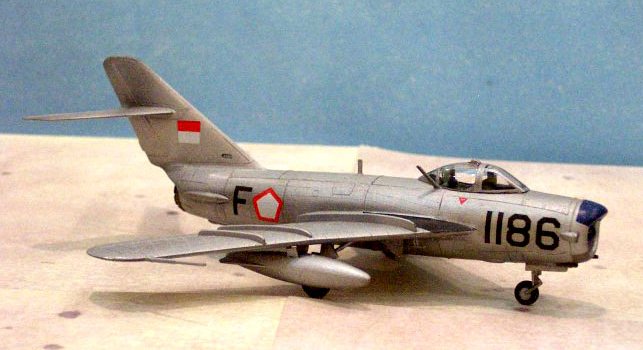
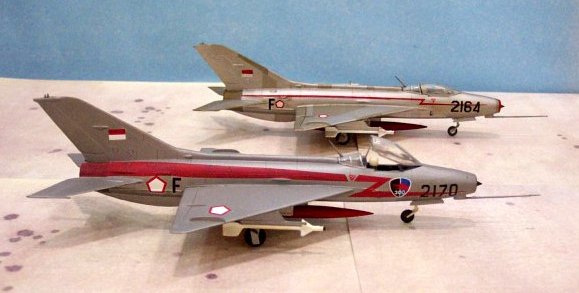
kinds of MiG also arrived comprising MiG-15UTI, MiG-17F/PF, MiG-19S and
MiG-21F-13, supported with Il-28, Mi-4, Mi-6 and An-12.
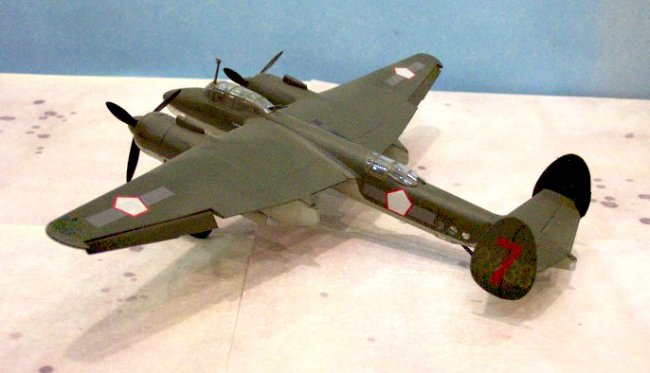
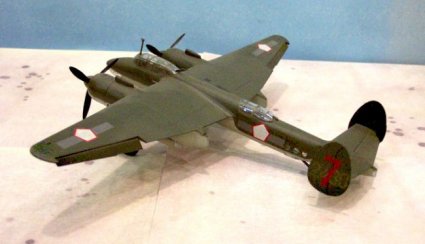
Some Tu-2 from China also arrived, intended to replace the B-25, but
sadly they never reached operational status.
These aircraft served along with the remaining western aircraft such as
B-25, A-26, C-47, and P-51. It was during this period that the Indonesian Air
Force became the largest air force in the southern hemisphere. This era also
marked the last confrontation with the Dutch in Papua, before the Dutch, again
under pressure of the United Nations, finally left Indonesia in 1963.
|
Click on image to the left
below to
see a larger image |
 |
 |
| Tu-2,
a lesser-known fighter bomber (by Iwan) |
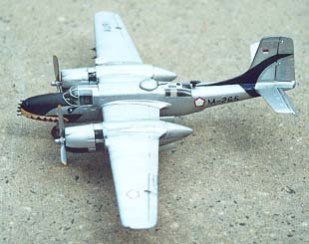
B-26
Invader, served until 1976 in Indonesia (by Erid) |
The
Present Days (1970-present)
The
revolution in 1965 changed everything and a new anti-communist regime took
power. Ties with the Eastern block countries were cut, and thus support and
spare parts for the planes became short. By the early 70’s most of the Eastern
block planes are either grounded or scrapped. The largest air force in the
southern hemisphere slowly but sure became one of the smallest one.
The
new government turned to the Western countries for support and “new” planes
started to arrive comprising T-33 trainers from USA (which were later modified
by Indonesian technicians to became AT-33 with internal canons and provisions to
carry FFAR rockets) and Avon Sabres (ex-RAAF) from Australia.
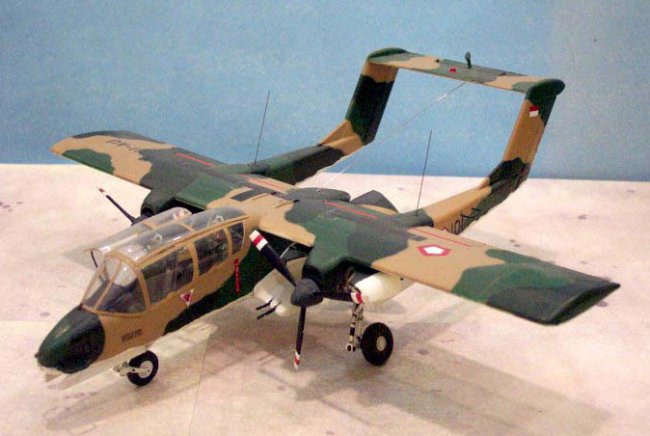
These were later enhanced with OV-10F Broncos. The next batches came in
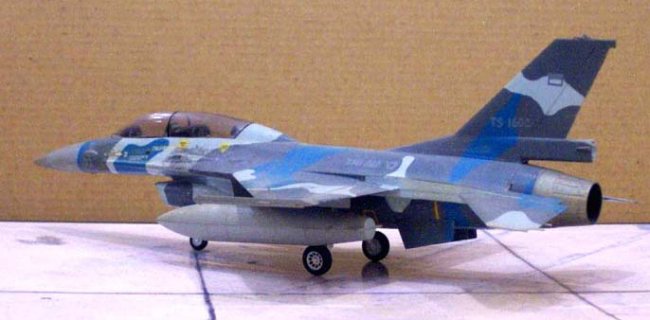
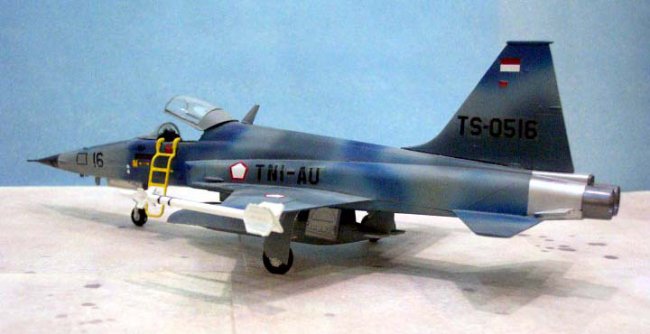
the form of ex-Israeli A-4E Skyhawk, Bae Hawk Mk. 53, F-5E/F Tiger II (in 80’s
era), followed by F-16A/B, and Hawk 109 & 209 (in 90’s era).
Aerobatic Teams
| Aerobatic teams in the
Indonesian Air Force were never formed as a special team, but the long
historical journey of Indonesian Air Force did marked several aerobatic
moments. Beginning in 1962, several MiG-17s demonstrated some aerobatic
shows in front of the high level officials. (see MiG-17 photo further
above in this article). Then in 1978, Spirit 78 using Avon Sabres was
formed, followed by Spirit 85 (1985) using 5 Bae Hawk Mk.53.
The tradition continued when the F-16s came
to the force and “Elang Biru” was formed with the
help of USAF’s Thunderbirds instructors. Elang Biru flew several tours
and their last performance was in Indonesian Air Show 96. The lesser-known
Jupiter Team was formed later, using Hawk Mk.53 and finally evolves into
the current aerobatic team known as the Jupiter Blue, using F-16, Hawk 53
and Hawk 109.
|
| Click
on image below to see larger image |
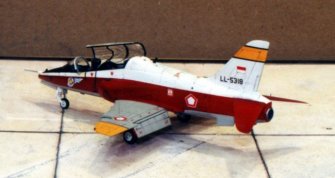 |
| Hawk
Mk.53 of Spirit 85 aerobatic team (by Alex) |
|
Indonesian Scale Model Society
Please
visit www.isms.150m.com
Thank-you to all modelers who
had shared their AURI’s aircraft models to support this article : Andre,
Masato, Rahman, & Erid
Alexander, Iwan,
Andre,
Masato, Rahman & Erid
|
|